
A house that overheats by noon, depends on mechanical cooling all day, and turns its back on the landscape may still look expensive. It just does not perform with the same intelligence. That is one of the clearest ways to understand why sustainable architecture is important. It is not simply about reducing harm. It is about creating buildings that are more livable, more resilient, and more meaningful in the places they inhabit.
For clients shaping a private residence, a boutique hotel, or a larger development, sustainability has moved far beyond certification checklists or surface-level green features. The real value lies in architecture that works with climate, light, material, and terrain from the beginning. When that happens, sustainability is no longer an add-on. It becomes part of the building’s character, its comfort, and its long-term worth.
Why sustainable architecture is important in practice
Buildings have a long life and a large footprint. They consume energy, use water, rely on material extraction, and influence how land is occupied for decades. Decisions made during design echo far beyond construction. Orientation, shading, ventilation, structural efficiency, and material selection all shape how much a building demands from its environment over time.
This is why sustainable architecture matters at a fundamental level. A well-designed building can reduce operational energy without sacrificing comfort. It can preserve more of a site’s ecology rather than overpower it. It can age with dignity because it was designed around durability and maintenance, not novelty. Good sustainable architecture is less about gadgets and more about intelligence – knowing when to open a space to the breeze, when to protect it from solar gain, and how to use local resources with restraint.
In tropical and coastal settings especially, architecture cannot afford to ignore climate. Heat, humidity, salt air, rainfall, and changing weather patterns quickly expose buildings that were designed as generic objects. Climate-responsive design creates another outcome. Deep overhangs, filtered light, natural cross-ventilation, protected outdoor living, and carefully chosen materials can make a building feel effortless while dramatically improving performance.
Sustainability improves daily experience
There is a tendency to discuss sustainability only through environmental metrics. Those matter, but they are not the whole story. People experience architecture through temperature, air movement, daylight, acoustics, and the quality of connection to the outdoors. Sustainable design often improves these qualities in very tangible ways.
A naturally ventilated room feels different from one sealed off from its surroundings. A shaded terrace that catches the prevailing breeze extends how a home or hotel is actually used. Soft daylight reduces glare and makes interiors calmer and more refined. These are not secondary benefits. They are central to how architecture supports well-being.
For high-end residential and hospitality projects, this point is especially relevant. Luxury is no longer defined only by scale or finishes. Increasingly, it is defined by ease, atmosphere, privacy, and a sense of belonging to the landscape. Sustainable architecture can produce spaces that feel cooler, quieter, lighter, and more restorative. It creates comfort with less mechanical intervention, which is both environmentally responsible and experientially richer.
Long-term value is part of why sustainable architecture is important
Sophisticated clients tend to look beyond first impressions. They consider how a property will perform over time, how it will be maintained, and how it will be perceived in a market that is becoming more climate-aware. Sustainable architecture supports all three.
Buildings designed around passive principles often have lower operating costs because they reduce dependence on artificial cooling, lighting, and complex systems. They can also hold value more effectively because performance and resilience are becoming part of what buyers and guests expect. A home or hotel that responds well to climate feels future-ready. One that ignores basic environmental realities may become expensive to operate and difficult to adapt.
There is also the question of durability. Sustainability is not only about using less. It is about building in a way that lasts. Materials suited to local conditions, details that manage water correctly, and structures that are straightforward to maintain all contribute to longevity. This is particularly important in environments where intense sun, heavy rain, and humidity can quickly degrade poorly resolved construction.
That said, sustainability is not always the cheapest path at the outset. Better detailing, thoughtful material sourcing, and site-sensitive planning can require more rigor early on. But the trade-off is often a building that performs better, ages better, and asks less of its owner over time. In premium architecture, that is usually the more intelligent investment.
Place matters more than ever
One of the most overlooked reasons why sustainable architecture is important is that it protects against placeless design. Too much contemporary construction could be dropped into almost any setting without changing very much. The result is often visually polished but environmentally indifferent.
Sustainable architecture begins with a different question: what does this place need? The answer may come from topography, native vegetation, seasonal winds, local craft traditions, or the path of the sun across the site. Designing from those realities tends to create architecture with greater depth and specificity.
This approach also strengthens cultural and material continuity. Local sourcing, when done well, can reduce transportation impact while supporting regional economies and craftsmanship. It can give a project a more grounded and authentic expression. Of course, local is not automatically better in every case. Some contexts require imported systems or specialized materials for performance reasons. The goal is not purity. It is discernment – selecting resources that make environmental, technical, and architectural sense together.
For global clients building in distinctive landscapes, this balance is essential. The most compelling projects do not impose an imported idea of luxury onto a site. They translate quality through climate intelligence, material honesty, and a close reading of context.
Technology helps, but design comes first
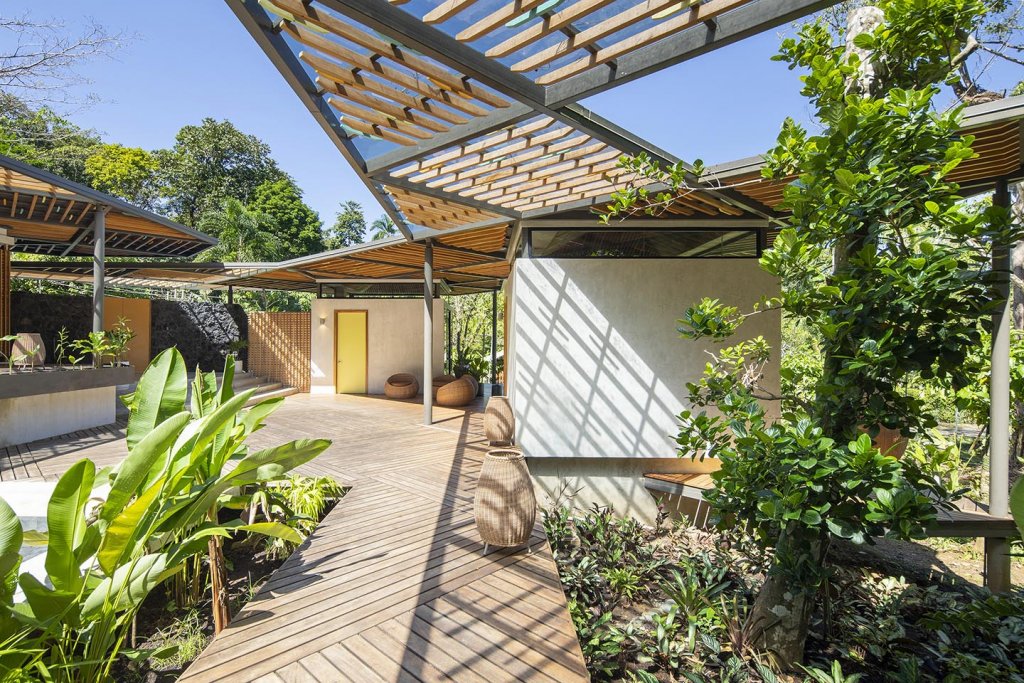
There is no shortage of new products marketed as sustainable. Some are useful. Some are expensive distractions. The deeper value of sustainable architecture comes from getting the fundamentals right before adding layers of technology.
Passive strategies usually deliver the greatest impact. Building orientation, roof design, thermal protection, operable facades, landscape integration, and water management can all shape performance at a foundational level. When these moves are embedded in the architecture, the project often requires less equipment to achieve comfort and efficiency.
This does not mean advanced systems have no place. On larger developments, hospitality projects, or highly serviced homes, renewable energy, water recycling, and high-performance building systems can be extremely effective. But technology should support the architecture, not compensate for design decisions that ignored climate from the start.
The most elegant projects tend to be the ones where sustainability is almost invisible because it feels so natural. A shaded courtyard, a roofline tuned to sun and rain, a structure opened to prevailing breezes – these moves carry a quiet sophistication that no amount of technical overlay can replace.
Sustainable architecture and resilience
Climate change has made resilience impossible to separate from good design. Rising temperatures, stronger storms, water stress, and coastal vulnerability are changing the way buildings need to perform. Sustainable architecture matters because it prepares projects for these pressures rather than pretending they do not exist.
Resilience can take many forms. It may mean elevating a building in a flood-prone area, specifying materials that withstand salt exposure, reducing heat gain during hotter seasons, or designing landscapes that absorb heavy rainfall more effectively. It may also mean reducing dependence on fragile infrastructure through passive cooling and water-conscious planning.
Not every project faces the same risks, and responses should never be generic. A mountain retreat, a tropical resort, and an urban mixed-use development require different strategies. What matters is that resilience is considered as a design opportunity rather than a constraint. Some of the most memorable architecture emerges from this discipline because it is shaped by real conditions, not abstract imagery.
A more intelligent idea of luxury
The old model of luxury construction often celebrated excess – oversized systems, overconditioned interiors, imported finishes, and architecture that was visually dramatic but environmentally tone-deaf. That model is losing relevance. Clients are more informed, guests are more discerning, and the expectations around performance have changed.
Today, a more enduring form of luxury is taking its place. It is defined by proportion, atmosphere, natural comfort, material integrity, and a strong relationship to the landscape. Sustainable architecture supports this shift because it asks better questions from the beginning. How can a building belong here? How can it offer comfort through design rather than force? How can beauty and responsibility reinforce each other?
This is where firms such as Studio Saxe have helped push the conversation forward, showing that environmentally responsive design can be internationally recognized, highly refined, and deeply site-specific at once. Sustainability, in that sense, is not a compromise on ambition. It is what gives ambition substance.
The projects that endure are rarely the ones that chase attention the fastest. They are the ones that feel inevitable in their setting, generous in their performance, and calm in the way they meet daily life. If a building can do that while reducing its environmental burden, it offers something far more valuable than trend-driven design. It offers a way of building that remains relevant long after the first impression fades.